
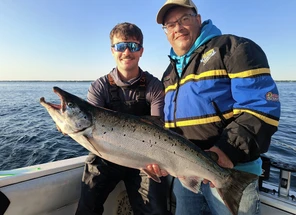
Posted by Great Lakes Fishing Podcast on 24th Apr 2026
Why Chinook Sizes Changed & Atlantic Salmon Are Surging in Lake Ontario
If you fish Lake Ontario for salmon and trout, you’ve probably noticed something interesting in the past few seasons. Chinook catch rates have been strong. Coho fishing surprised a lot of anglers in 2025. Atlantic salmon are showing up more frequently than they have in generations. Meanwhile, questions continue about baitfish populations and why 30-pound kings aren’t as common as they once were.
At the Greater Niagara Fishing Expo, we sat down with New York DEC Lake Ontario Unit Leader Chris Legard and charter captain Rob Westcott of Legacy Sportfishing to talk through the current “state of the lake.” Their conversation provided one of the clearest pictures yet of where the fishery stands today—and where it’s headed next.
The big takeaway? Lake Ontario’s salmon fishery is in a very strong position right now.
The Alewife Population Has Rebounded—and That Matters
If there’s one species that drives everything in the Lake Ontario open-water fishery, it’s alewives.
Alewives make up roughly 98% of the pelagic prey base in the lake. That means salmon growth rates, survival rates, and stocking decisions all depend heavily on what happens with bait.
Between roughly 2016 and 2020, managers saw warning signs. Alewife reproduction dropped for multiple consecutive years, creating concerns about predator-prey balance. That led to stocking adjustments intended to protect the long-term stability of the fishery.
Since then, reproduction has improved significantly.
Recent surveys conducted cooperatively by the New York DEC, USGS, and Ontario’s Ministry of Natural Resources show multiple strong alewife year classes entering the system. In fact, the abundance of one-year-old alewives in 2025 was among the highest observed in decades.
Many anglers noticed.
If you saw bait stacked in harbors across the south shore last spring, that wasn’t your imagination. Those strong year classes translated directly into visible forage everywhere from western ports to the eastern basin.
Even the alewife die-off some anglers observed along the shoreline wasn’t considered a major concern. According to DEC testing, the event was linked to natural stress from population density and temperature swings—not disease.
That’s an important distinction for anglers watching the health of the fishery closely.
Why Chinook Salmon Catch Rates Are So Strong Right Now
Chinook salmon remain the backbone of Lake Ontario’s offshore fishery. And the numbers over the past several years have been impressive.
Since 2017, Chinook catch rates have been among the highest recorded in the entire history of the DEC creel survey program, which dates back to 1985.
That’s remarkable consistency across nearly a decade.
When you combine strong catch rates with a recovered bait base, you end up with a fishery that’s producing reliable action across multiple ports and seasons.
But there’s a tradeoff anglers sometimes overlook.
Shop Fish Hawk Electronics Systems
Where Did the 30-Pound Kings Go?
One of the most common questions heard at seminars and dockside conversations is simple:
Why aren’t we seeing as many giant Chinook salmon anymore?
The answer isn’t complicated.
According to DEC research, the biggest factor influencing Chinook size is Chinook abundance itself.
When Chinook numbers are high, average fish size tends to drop. When salmon numbers are lower, individual fish often grow larger.
It’s a classic predator-prey balance relationship.
Right now, the lake has strong Chinook abundance and a healthy forage base. That supports excellent catch rates, but it spreads available food across more fish.
Even so, average August age-three Chinook recently topped 20 pounds—still an excellent benchmark by historical standards.
And 30-pound fish are still caught every year.
They’re just not as common as they were during lower-density salmon cycles.
The Role of Wild Chinook Salmon in Lake Ontario
Another fascinating development in recent years is how many Chinook salmon in Lake Ontario are naturally reproduced rather than hatchery-stocked.
Previous studies showed wild fish could represent anywhere from 30% to 70% of the Chinook population, depending on year class and location.
Now, new genetic parentage-based research is helping managers track those numbers more accurately every year.
Instead of physically fin-clipping millions of stocked fish, scientists now build a genetic reference library from hatchery broodstock. When scale-sampled fish are analyzed later, researchers can determine whether they originated from hatchery parents or wild spawning.
It’s faster, more efficient, and opens the door to better long-term management decisions.
Even better, anglers themselves are helping collect some of the samples needed to support the research.
Programs involving charter captains and volunteers from Lake Ontario Trout & Salmon Association and Eastern Lake Ontario Salmon & Trout Association members are playing a growing role in advancing this work.
That kind of collaboration between anglers and fisheries managers is becoming one of the defining strengths of the Lake Ontario fishery.
Atlantic Salmon Are No Longer a “Unicorn Fish”
For years, Atlantic salmon in Lake Ontario were something anglers talked about more than they actually caught.
That’s changing.
Atlantic salmon are native to Lake Ontario, but restoration efforts dating back decades struggled to produce consistent returns. Until recently, annual stocking numbers remained relatively small.
In 2021, that changed.
Stocking numbers increased significantly—from roughly 50,000 fish annually to around 200,000—and stocking locations shifted closer to river mouths instead of upstream sites.
Those adjustments are already paying off.
Anglers are encountering Atlantic salmon more frequently both in tributaries and the open lake. In fact, recent seasons have produced the strongest Atlantic salmon presence observed in modern Lake Ontario history.
While most Atlantics are still hatchery fish today, the long-term goal remains increasing natural reproduction through habitat restoration.
That’s a slower process—but progress is clearly underway.
Why Coho Salmon Fishing Was So Strong Last Season
If you spent time on Lake Ontario in 2025, you probably noticed something else:
Coho salmon fishing was outstanding.
In many ports, cohos filled the gap during a period when Chinook fishing didn’t develop as quickly as expected.
That success likely came from two factors working together:
First, managers shifted stocking strategy several years ago away from fall fingerlings toward spring yearlings, which survive at higher rates.
Second, natural reproduction appears to contribute significantly to certain year classes.
Because most cohos are caught as two-year-old fish, their population tends to follow boom-and-bust cycles depending on survival conditions in any given year.
Last season was clearly a boom year.
And in many areas—including waters where cohos were previously considered occasional bycatch—anglers were able to target them successfully throughout the spring fishery.
New Brown Trout Genetics May Improve Survival
Brown trout are another important piece of the Lake Ontario multi-species fishery.
Recently, the DEC introduced updated genetics into its long-running Rome strain brown trout program by crossing hatchery fish with wild males.
The goal is simple:
Improve post-stocking survival.
Over time, hatchery strains can become conditioned to artificial environments. By introducing wild genetics, managers hope stocked fish behave more naturally after release and avoid predators more effectively.
Anglers should begin seeing the results of that change in upcoming seasons as those year classes mature.
Angler Participation Is Helping Shape the Future of the Fishery
One of the most encouraging trends in Lake Ontario fisheries management today isn’t biological—it’s collaborative.
The Lake Ontario Fishery Advisory Panel brings together tributary anglers, lake anglers, and stakeholders from across the region to help managers evaluate decisions before they’re implemented.
That level of communication didn’t always exist.
Today, it plays a major role in shaping stocking strategies, research priorities, and long-term planning.
Programs like Chinook pen-rearing projects and genetic sampling initiatives also rely heavily on volunteer participation.
For many anglers, helping support the fishery has become just as important as fishing it.
A Fishery Built on Flexibility
One of Lake Ontario’s greatest strengths is diversity.
Even when Chinook fishing slows temporarily, anglers still have opportunities to target cohos, brown trout, steelhead, lake trout, and Atlantic salmon, depending on the season and location.
That flexibility keeps charter captains productive and recreational anglers successful even when conditions change.
It’s also a major reason why Lake Ontario continues to rank among the top freshwater fisheries in North America.
According to DEC leadership, catch rates remain historically strong, baitfish populations are healthy, and Atlantic salmon restoration is gaining momentum.
That’s a combination anglers don’t take for granted.
And it’s why the outlook for the lake remains extremely positive heading into the seasons ahead.